
Probable urea poisoning of 18 of 950 cattle
Unusual presentation:
18 of 950 BrahmanX cattle found dead or dying shortly after exposure to a new batch of lick blocks
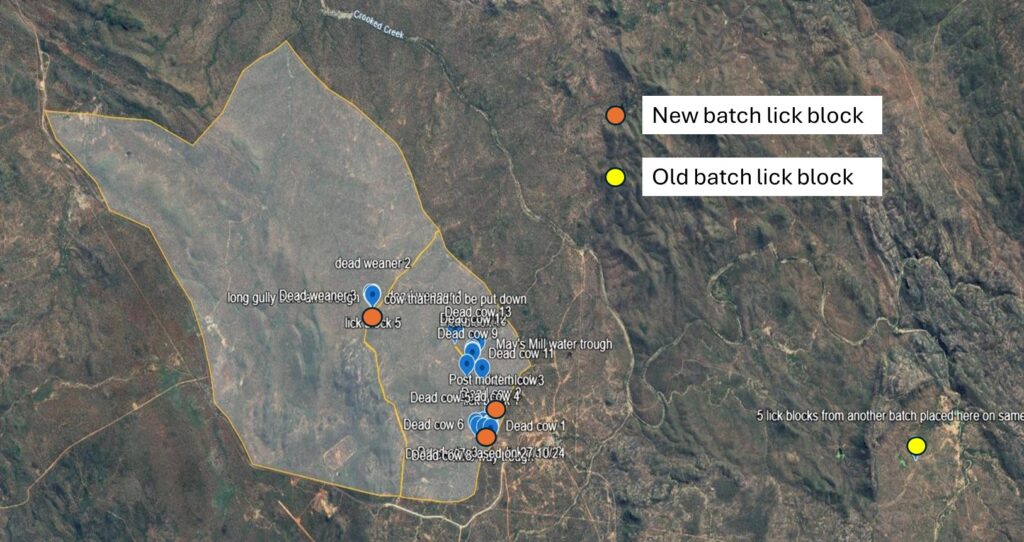
Above: Location of dead and dying stock in relation to lick blocks
Time and location: October 2024 on a cattle property in Far North Queensland.
Case definition: Cows and weaners found dead or recumbent, twitching and dehydrated within a few hundred meters of urea lick blocks that had been put out two days before.
Disease mapping: Approximately 500kg of urea cattle lick blocks from a new batch had been distributed across three sites. Mapping the location of the dead animals in relation to the licks and water troughs showed all had occurred within a few hundred metres of the lick blocks from the new batch. An additional site with lick blocks from the previous batch had no associated deaths.
Gross findings: A mature cow that was alive but unable to rise was euthanised for post-mortem examination. No significant abnormalities were found.
Field differential diagnoses:
• Urea poisoning
• Unspecified toxicity from lick blocks or water sources
Laboratory findings:
- Biochemistry and histopathology: No significant findings.
- Rule outs: Negative Haemophilus spp culture; Negative Bovine ephemeral fever virus detection by real-time PCR; Negative Bovine herpesvirus-1 detection by real-time PCR
- Water samples: Normal stock water quality readings. No cyanobacteria (blue-green algae) detected.
- Aqueous humour ammonia levels within normal range. Note: Ammonia concentrations of >1000 uM in fresh plasma / serum / eye fluids are expected with Urea toxicity but may normalize 48 hours post toxic intake.
Animal / management / environment risk factors: On examination lick blocks from the new batch appeared unusually soft on top. Consumption rates were estimated for one paddock known to contain 200 head of cattle. Approximately 300 kg of lick blocks were consumed over 48 hours, giving an estimated intake of urea per head of 225 g/day (safe limit: 60 g/day).
The likely cause of the deaths was considered to be urea poisoning, despite inconclusive test results, based on:
- Timeline and spatial patterns: Deaths occurred shortly after exposure to the affected batch of lick blocks and ceased immediately after removal.
- Excessive consumption: Estimated daily intake exceeded safe limits by nearly four times.
- Clinical signs and symptoms: Twitching and inability to rise align with urea toxicity.
- Product characteristics: The affected batch’s unusual softness allowed for overconsumption.
Recommendations:
Immediate Actions:
- Remove all remaining lick blocks from the new batch.
- Monitor cattle closely for further symptoms of urea toxicity.
Future Preventive Measures:
- Gradually introduce cattle to new urea-based supplements to allow for acclimatization.
- Conduct batch inspections for abnormalities in texture or consistency before use
- Implement daily or periodic consumption monitoring to detect anomalies early.