
Extensive necrotising skin lesions in young cattle
Unusual presentation:
Over a one-week period after heavy rain, 18 young steers and heifers developed severe and extensive necrotising skin lesions on their flanks and sides. Similar lesions had been observed in a smaller number of young cattle on the same property in the 2022 and 2024 wet seasons.
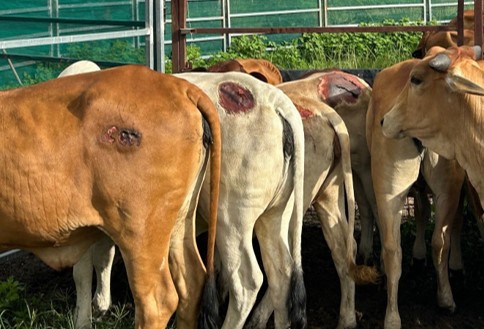
Above: Young cattle with areas of skin sloughing at about day 12
Time and location: In February 2025, in Far North Queensland
Case definition: Necrotising skin lesions primarily developed on the flanks, often associated with the site of fire branding but, in some cases, appearing on the back or sides without direct relation to the brand site. Lesion sizes ranged from a few centimetres in diameter to the size of a dinner plate, occasionally extending forward over the flank. The skin at the periphery of the lesions was inflamed and pruritic, leading to frequent licking by affected animals. The necrotic skin sloughed, leaving an open, raw granulating wound.
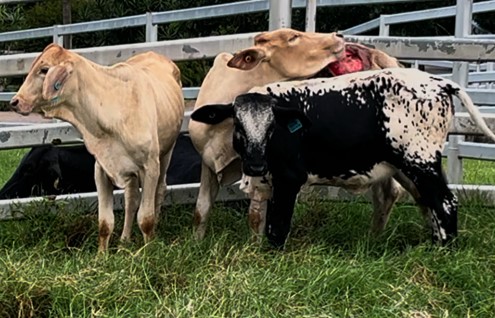
Above: Pruritic lesions were licked frequently
Disease mapping:
Spatial Clustering: The cattle were bred on a property located 40 km away and transported to the home property when weaned. Lesions only occurred on this home property where the cattle were rotationally grazed across four pasture paddocks dominated by Wynn Cassia.
Temporal Clustering: 18 cases occurred in early February of 2025. In previous years cases occurred in January, February, and April of 2022 (four cases) and April of 2024 (two cases). Cases appeared to cluster in the days or weeks following heavy rainfall events ranging from 50–250 mm per week.
Clustering in Animal Characteristics: During the 2025 outbreak only young cattle were affected. Unweaned and unbranded calves (n=2), as well as older cattle (8 cows, 2 bulls), remained unaffected. All breeds on the property, including Brahman, Brahman crosses, and one British breed animal, were affected. In previous outbreaks cases occurred in red-coated Droughtmaster heifers and steer, white Brahman heifers and a British breed steer. 10 of 12 heifers that were purchased in December 2024 and transported to the property were affected.
In 2025, lesions developed in animals either one week or five months post-branding. Animals branded in January were 1.62 times more likely to develop lesions than those branded in the previous September. The branding technique was identical in January and September, utilizing a gas-fired three-piece brand.
Gross PM examination: One severely affected animal had bloods collected and was euthanized for post mortem examination. No abnormalities were detected in the internal organs. Fresh and fixed samples and swabs were collected from the centre and margins of the lesions and healthy skin.
Lab findings: Bacterial and fungal culture studies performed to date have failed to identify a significant pathogen. Histological skin lesions show a vasculitis suggestive of an unidentified bacterial process, however, trauma as an inciting cause cannot be excluded.
Further testing has been undertaken to explore the possible role of Mycobacterium spp (of particular interest is Mycobacterium ulcerans which causes Buruli/Bairnsdale ulcer). Results to date: ZN stain (negative), PCR (weak positive non-specific), genome sequencing (unidentified Mycobacterium) and ongoing culture (can take up to 2-3 months for a result). Other bacteria isolated could be pathogenic or background contaminants and testing continues.
Biochemistry and histopathological examination of the liver did not demonstrate pathology that could cause the lesions. Although this does not rule out a primary photosensitization, the distribution of the lesions and presence in pigmented skin make this very unlikely.
Animals tested negative for pestivirus (antigen and antibody), malignant catarrhal fever and lumpy skin disease.
Management / Environment / Animal factors (reducing resistance or increasing exposure): There is a strong association between branding wounds and lesion location, and occurrence during the wet season, particularly after heavy rainfall. The disease predominantly affects young cattle of multiple breeds and skin colours.
Potential contributing factors include: High wet-season rainfall, heat, and humidity / Insect irritation / compromised skin integrity due to branding wounds, yarding, transport injuries, insect bites, or possible mechanical trauma from bulls. These environmental conditions are common across northern Queensland, yet this outbreak is highly localised, suggesting additional unidentified contributing factors.
A previous NABSnet SDI case with very similar presentation was recorded in February 2023 on an unrelated property 700km from this farm.
Diagnoses that can be excluded: Based on the laboratory testing undertaken on samples taken from live animals and on necropsy the following aetiologies can be excluded:
- Some bacterial and fungal causes including dermatophilosis (rain scald) and dermatophytosis (ringworm)
- Viral causes: LSD (capripox); Papillomavirus; Bovine popular stomatitis, pseudocowpox; Malignant catarrhal fever
- Insect hypersensitivity
- Parasitic causes including mites, lice and ticks
- Primary and secondary photosensitisation
- Nutritional causes including copper, zinc and vitamin A deficiencies
- Neoplasia
Unresolved questions include:
- What causes a small wound, usually associated with branding, to develop into extensive necrotising lesions?
- Why do some lesions emerge five months post-branding?
- How do non-brand-associated lesions develop?
- Why do similar branding practices on other properties under comparable weather conditions not result in lesions?
- Are there common contributing factors with the similar cases 700 km away?
Recommendations (to increase resistance and reduce exposure):
- Avoid branding cattle during the wet season and preferably brand at the wetland property
- Review the branding technique – too hot or too long?
- Watch for any unusual plant that might be ingested when Wynn Cassia is relatively unpalatable
- Contact the vet practice to sample at the very first suggestion of new lesions
- Until the cause is better understood, consider implementing enhanced monitoring of branding (and other wounds), and provide affected cattle with access to shade and insect protection.
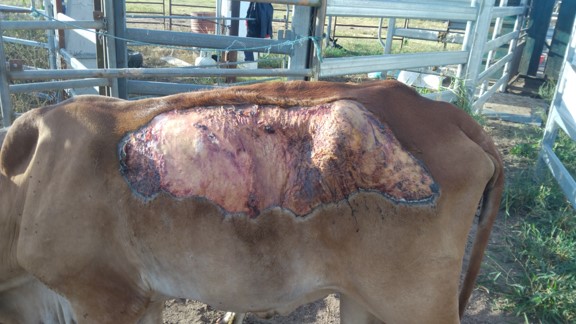
Above: Lesion at about 3 months